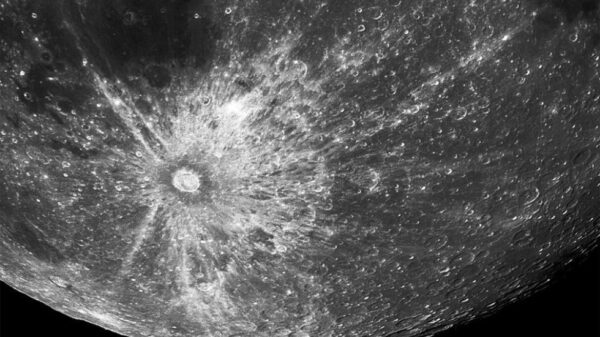
Upon analyzing lunar samples from the Chang’e-5 mission, gathered from the Moon’s near side, researchers discovered significant quantities of multilayered graphene indigenous to the Moon. This finding contests the long-standing hypothesis that the Moon’s formation through a colossal impact led to a depletion of its carbon reserves, a theory previously corroborated by Apollo mission samples.
The origin of the Moon has long been a topic of vigorous debate, with various hypotheses put forward. Many of these are grounded in the discovery and measurement of carbon, a critical element for deciphering the formation and evolution of celestial bodies. Analyses of samples from the Apollo missions have led to the widespread belief that a colossal collision resulted in the carbon depletion of our Moon.
Yet, recent studies challenge this view, uncovering substantial carbon sources on the Moon. One such study detected carbon ion emissions across the lunar surface, indicating a local origin. It also posited that meteorite impacts might generate graphite carbon on the Moon’s surface.
To delve deeper into the origins of carbon on the Moon’s surface, researchers from Jilin University in China concentrated on samples gathered by the Chang’e-5 lunar probe in 2020. They argue that understanding the crystalline structure of the root carbon phase through further analysis of young lunar samples is crucial for reaching a consensus on the Moon’s geological evolution, as detailed in their recent publication at journal National Science Review.
Graphene was formed as a result of volcanic eruptions and solar wind
In a recent study examining the origin of lunar carbon, scientists have concentrated on graphene, a form of graphite. Approximately 1.9% of interstellar carbon is believed to be graphene. Earlier research has also detected graphene within the protosolar cloud—the nebula from which the solar system originated—and in carbonaceous chondrites, a type of stony meteorite. Therefore, analyzing the structure of locally sourced graphene could yield insights into the geological evolution of celestial bodies.
The Chang’e-5 probe collected 1.7 kg of lunar samples from one of the youngest volcanic areas on the moon’s near side. Researchers employed Raman spectroscopy to analyze these samples, a sophisticated method for examining small lunar rock particles averaging 2.9 millimeters in diameter. Graphene was discovered in relatively large quantities, existing both as individual particles and in combination with other elements like sodium, magnesium, aluminum, silicon, calcium, tin, and iron. Additional analysis confirmed the presence of multilayer graphene.
Experts suggest that graphene forms in situ on the Moon due to catalytic processes from solar wind and volcanic eruptions. The presence of iron in carbon-rich areas implies a significant role in graphene’s formation. Moreover, graphene’s structure suggests high-temperature formation, likely from volcanic activity, enabling ferrous materials to react with carbon-rich gases in the solar wind, resulting in multilayer graphene.
“Importantly, this mechanism involves a carbon capture process on the moon that could lead to a gradual accumulation of local carbon,” the team explains in their report.
The presence of a local carbon source is what casts doubt on the validity of the giant impact hypothesis.
“Further study of the properties of natural graphene would provide more information about the geological evolution of the Moon,” experts suggest.
The findings also offer crucial insights into the resources present on the lunar surface, which are essential for setting up future manned lunar bases.