Once upon a time, the world was ruled by the Titans—powerful beings, children of Gaia (Earth) and Uranus (Sky). They were the great masters of the world for a long time. But nothing lasts forever! The reign of the Titans came to an end when Kronos, the youngest of the Titans, overthrew his father Uranus, disarmed him, and cast him into the abyss of Tartarus.

Uranus, from the gloomy depths of Tartarus, cursed the Titans, causing their power to wane. Yet, Kronos emerged as the most powerful among them, becoming the master and lord of Time.
Kronos was the strongest and most ruthless of the Titans; no one could oppose him. He married his sister Rhea, the goddess of earth and fertility, and they gave birth to new gods.
However, Kronos harbored no affection for his children and even despised them, knowing the prophecy that one of his sons would overthrow him, just as he had overthrown his father Uranus.
In his cruelty, Kronos dealt harshly with his offspring: he devoured them at birth, preventing them from growing up and gaining power.

Rhea, their mother, loved and grieved for her children, refusing to accept their tragic fate. She managed to hide her youngest child, Zeus, on the island of Crete, giving Kronos a stone wrapped in swaddling clothes instead. Kronos swallowed the stone, unaware of the deception.
Zeus grew up in Crete, cared for by nymphs and nourished by the goat Amalthea. As he matured, Zeus learned the truth about his origins from his mother, Rhea, and decided to free his siblings and overthrow Kronos. He devised a cunning plan, replacing Kronos’ drink with a potion made from the omphakos plant, which induced vomiting. Kronos drank the potion and regurgitated Zeus’ siblings: Poseidon, Hades, Hera, Demeter, and Hestia.
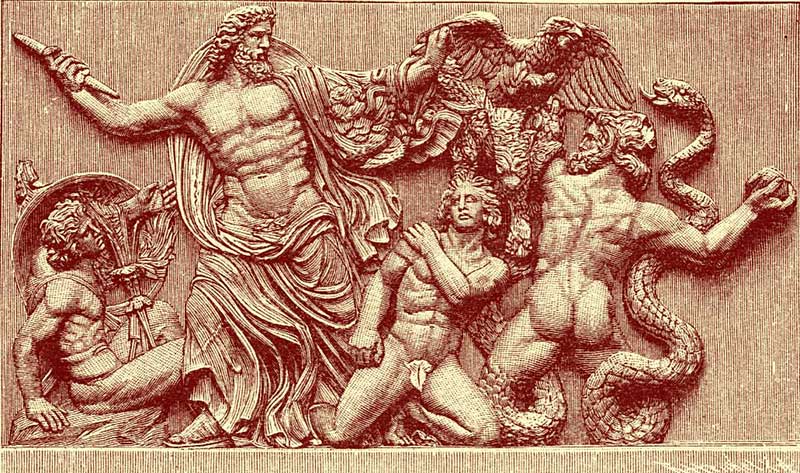
United under Zeus’ leadership, the gods could not forgive Kronos for their suffering and joined forces against him and the Titans, initiating a battle for control over the world.
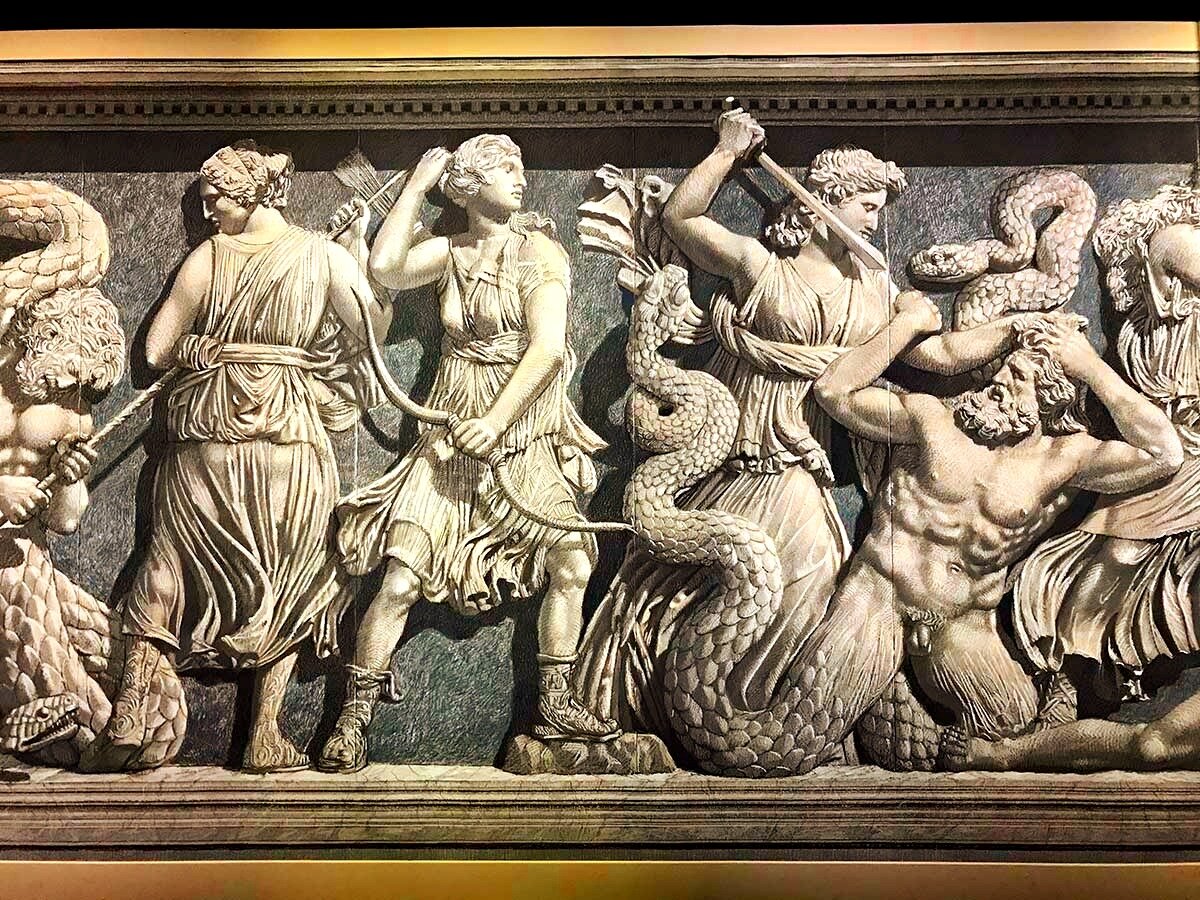
The Titanomachy was a long and merciless war between the Titans and the gods.
It was a fierce struggle that lasted for ten years. Thunderclaps and lightning flashed from the heavens, the earth trembled under the powerful steps of the Titans, and the sea heaved from Poseidon’s waves. The gods received support from their friends and allies: the Cyclopes, one-eyed giants who forged lightning for Zeus; the Hekatonkheires, terrible monsters with a hundred arms who threw mountains at the Titans; and Prometheus, a Titan who joined the gods.
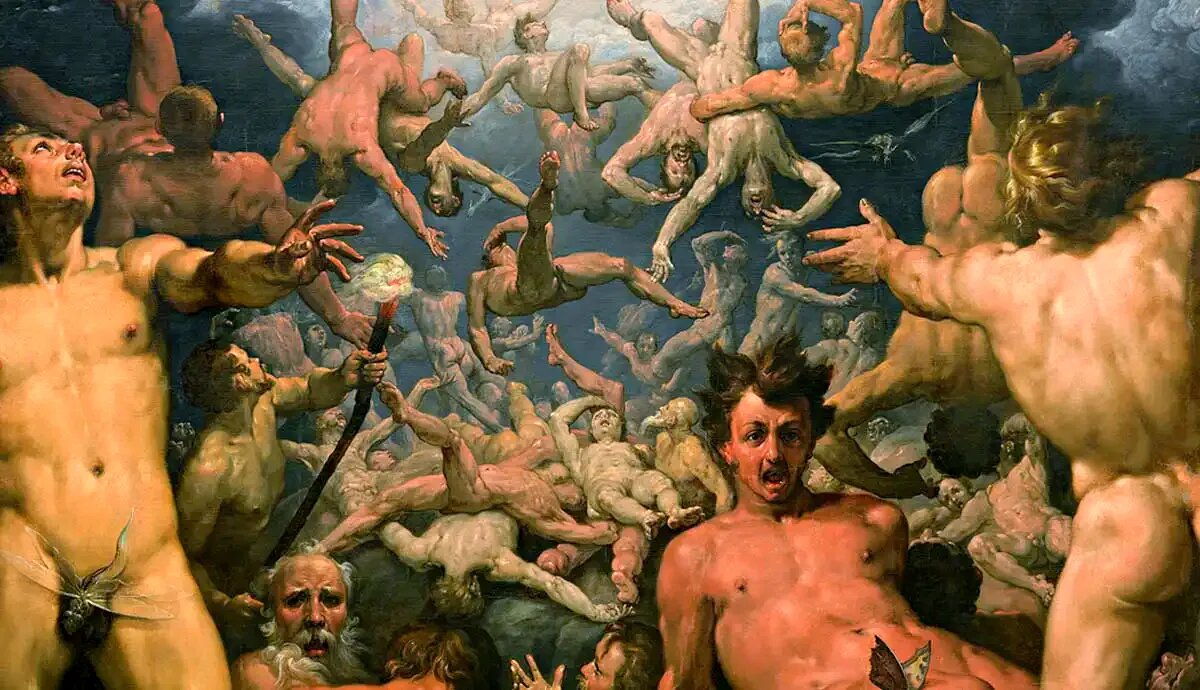
The gods triumphed over the Titans in a spectacular victory! Zeus imprisoned Kronos and the vanquished Titans in Tartarus, a deep abyss beneath the earth, where they would suffer eternally. Only a few Titans managed to escape this grim fate: Prometheus, who later became a benefactor to humanity; Epimetheus, who married Pandora; and Oceanus, who remained neutral during the conflict.
Prometheus, who became the patron and protector of the entire human race;
Atlas – he was condemned, but forgiven, but ordered to carry the firmament on his shoulders;
Iapetus and his sons Menetius, Epimetheus and Atlas;
Oceanus and his wife Tethys;
Hyperion and his wife Phoebe;
Coyos and his wife Phoebe; Krios and his wife Eurybia;
the goddess of memory Mnemosyne;
the goddess of justice Themis, who became the second wife of Zeus;
the goddess of order Temis;
and, of course, the mother of the gods, Rhea.
Genealogy of the Olympians in Greek mythology.
The Age of the Titans ended, ushering in the Age of the Gods. Zeus ascended to the top of the universal throne, sharing power with his brothers: Poseidon took control of the sea, and Hades ruled the underworld. Zeus retained dominion over the cosmos and the earthly world inhabited by humans.
The main gods did not overlook their sisters: Hestia was revered as the goddess of the hearth; Demeter as the goddess of agriculture and fertility; Hera as the goddess of marriage and motherhood, and she also became Zeus’s wife. The victors settled on Olympus, the highest mountain in Greece, where the Titans once lived. From there, the gods observed the lives of humans.

Although Kronos was not entirely defeated, his spirit continued to reside in the stone he swallowed instead of Zeus. This stone, known as Omphalos, symbolized the center of the Earth and was erected in Delphi, marking it as the new center of the Earth.
Another son of Kronos, Chiron, who was born to the nymph Philyra, survived unscathed. Chiron was a centaur with the torso of a human and the legs of a horse.
Chiron is renowned as a wise and benevolent teacher of many heroes in ancient Greek mythology, including Achilles, Hercules, Jason, and Asclepius. Initially immortal, he chose to relinquish his immortality after being accidentally wounded by a poisoned arrow shot by Hercules. Chiron’s legacy was immortalized in the heavens as the constellation Centaurus or Sagittarius.
Thus ended the age of the Titans, and the age of the Olympian gods began. Mythology is full of cycles and transformations, and the idea of a new hero rising to challenge Zeus adds an exciting twist. Who knows what new adventures and legends could emerge from such a change?